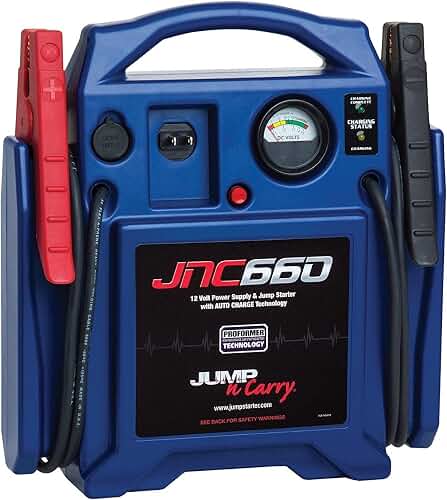
Comparison table
| Product | Peak amps | System | Engine rating | Capacity | Price |
|---|---|---|---|---|---|
| Clore Automotive Jump-N-Carry JNC660 | 1700A | 12V | Not stated | 22Ah battery | Check price on Amazon |
| FlyAuto 8000A 12V/24V Jump Starter | 8000A | 12V / 24V | Not stated | Not stated | Check price on Amazon |
| COSSIFTW Heavy Duty 10000A Jump Starter | 10000A | Not stated | All gas, up to 15L diesel | 130Wh | Check price on Amazon |
| YaberAuto 16-in-1 Jump Starter | 8000A | 12V | All gas, up to 14L diesel | 99.9Wh / 27000mAh | Check price on Amazon |
| WOLFBOX 4000A Jump Starter MV24 | 4000A | 12V | Under 10L gas and diesel | 88.8Wh | Check price on Amazon |
| NOCO Boost GB40 | 1000A | 12V | 6.0L gas / 3.0L diesel | Not stated | Check price on Amazon |
Quick answer: For most half-ton trucks and mid-size SUVs, the Clore Automotive Jump-N-Carry JNC660 1700 Peak Amp 12 Volt Jump Starter is the safest bet because it pairs 1700 peak amps with a 22Ah onboard battery and thick 46-inch #2 AWG cables. If you're starting big diesels, farm equipment or 24V commercial rigs, step up to the 8000A 12V/24V Jump Starter for Large Gas & Diesel Engines. And if you just want a compact lithium pack that lives in a glovebox for a gas V8, the NOCO Boost GB40 covers it for under $100.
The honest truth about "which jump starters work best for trucks" is that peak amps are the number everyone shops on and the number that tells you the least. What actually matters is cable gauge, the engine size the manufacturer rates the unit for, and whether the pack can handle a battery that's flat enough to not even register. Below are six options that span the range, and the specs that separate them.
Clore Automotive Jump-N-Carry JNC660 1700 Peak Amp 12 Volt — Best Overall
This is the boxy blue unit you see in a lot of shops, and it earns that spot on hardware rather than marketing. The Clore Automotive Jump-N-Carry JNC660 1700 Peak Amp 12 Volt Jump Starter puts out 1700 peak amps from a 22Ah Clore Proformer battery that's specifically designed for jump starting rather than for deep-cycle duty.
Finding the right best heavy duty jump starters trucks suvs comes down to matching the features to how you will actually use it.
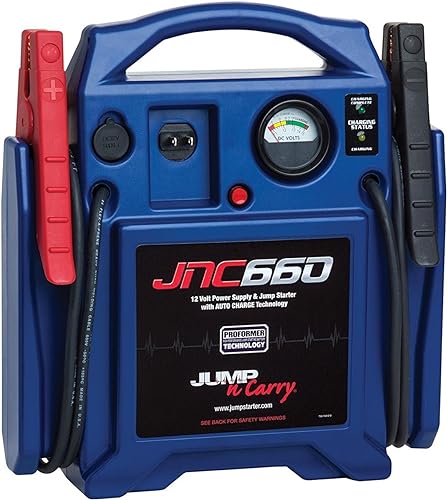
The details that matter for trucks are the cables: 46 inches of heavy-duty #2 AWG. That's long enough to reach a battery mounted deep in a full-size engine bay or under a step, and thick enough that you're not losing a chunk of your current to cable resistance on the way to the terminals. A lot of compact packs quietly cheap out here.
It also has an onboard voltmeter so you can see the unit's own state of charge before you rely on it, plus a 12V DC outlet for running accessories. At $118.43 it's not the cheapest thing here, and it's a bigger, carry-it-by-the-handle sort of tool rather than a glovebox pack. That's the trade. Check recent buyer reviews for how people report it holding charge over long storage periods.
FlyAuto 8000A 12V/24V Jump Starter — Best for Diesel and Commercial Rigs
If your fleet includes anything running a 24V system — many commercial trucks, some tractors and heavy equipment — most consumer jump starters are simply the wrong tool. The 8000A 12V/24V Jump Starter for Large Gas & Diesel Engines handles both 12V and 24V, which is the main reason to pay its $249.99 asking price.
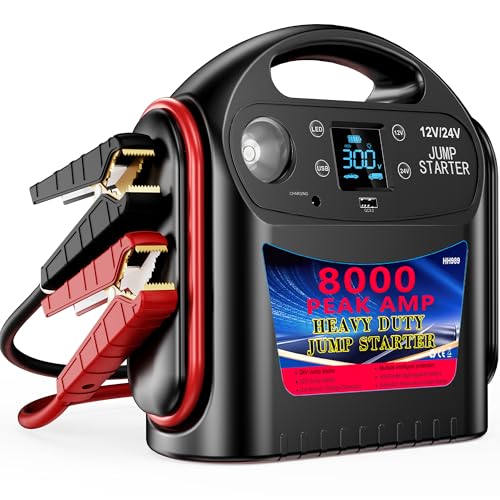
It's rated at up to 8000A peak and is pitched at cars, pickups, RVs, SUVs, vans, boats, tractors and commercial vehicles. It includes a Force Start function for deeply discharged or low-voltage batteries — the situation where a normal jump mode refuses to engage because it can't detect a battery at all. That's a genuinely useful feature on a work truck that's sat through a cold snap.
A digital display shows battery voltage, connection status and operating information, and there's USB charging plus an LED light. Safety protections cover reverse polarity, over-current, short circuit, overheating, overcharging and sparks. One note: the listing doesn't state a specific engine displacement rating, so if you're at the edge of what you think it'll handle, verify against your own engine before committing.
COSSIFTW Heavy Duty 10000A Jump Starter — Best for Big Diesels and Off-Grid Power
The COSSIFTW Heavy Duty 10000A Jump Starter Built-in AC 200W Inverter is the highest-rated unit here at 10000A, with EC8 smart clips on 6AWG cable, and it's rated for all gasoline vehicles and diesels up to 15L — trucks, RVs, agricultural and mining vehicles.
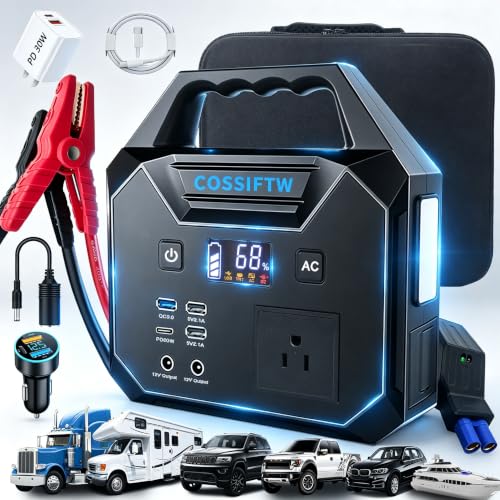
What makes it different from everything else on this list is the built-in 200W AC inverter running off a 130Wh battery. That means a real wall outlet in the cab, alongside USB and DC outputs that can all be used at once. COSSIFTW notes it can supply a ventilator, which tells you something about the intended use case. Total weight is 1.5kg, and it ships with the EC8 6AWG jumper cable, USB-C cable, charger, cigarette lighter converter and a carrying bag.
At $388.88 it's by far the most expensive option here, and you're paying for the inverter and the diesel headroom as much as the amps. Worth noting from the manufacturer: use the original 30W charger, power the unit off while charging, and top it up every three months if it sits unused.
YaberAuto 16-in-1 Jump Starter with Air Compressor 8000A — Best All-in-One Kit
If the failure mode you actually worry about on a road trip is "something goes wrong and I have nothing," the YaberAuto 16-in-1 Jump Starter with Air Compressor 8000A 160PSI is a lot of tool for $94.99.
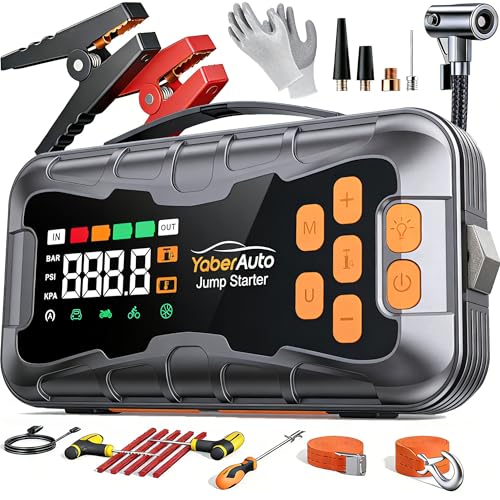
The jump starter side is 8000A with a Force Start function for completely dead or low-voltage batteries, rated for all gas engines and diesels up to 14L, with extended cables and an operating range of -4°F to 140°F. Standby time is quoted at around 24 months, which matters for something that lives in a truck bed box.
Then there's everything else: a 160PSI tire inflator running a 45L/min turbo that YaberAuto says takes a car tire to 30 PSI in about two minutes, with five inflation modes, four nozzles and a 3.3-inch screen with ±1 PSI precision and auto shut-off. Plus a 99.9Wh/27000mAh power bank with two 18W USB-A ports, an 800-lumen light with four modes, 400V insulated gloves, a tire repair kit, tow rope and escape hammer. Spark-proof and reverse-polarity protection are built in.
The catch with any do-everything device is that each individual function is usually a notch below a dedicated tool. If you already own a good compressor, you're paying for redundancy.
WOLFBOX 4000A Jump Starter MV24 — Best Budget Pick
The WOLFBOX 4000A Jump Starter MV24 sits at $96.89 and covers 12V vehicles including trucks and boats, with gas and diesel engines under 10 liters. That 10L diesel rating puts it comfortably within reach of a light-duty diesel pickup.
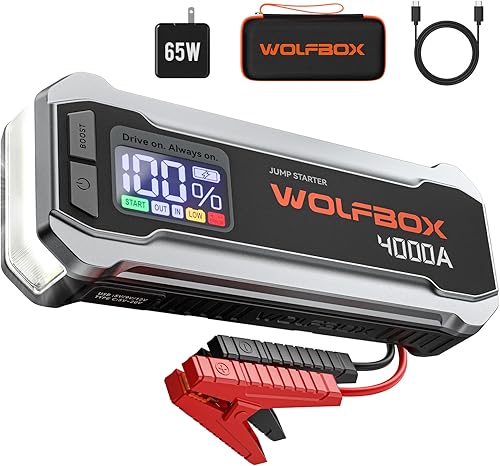
It runs an 88.8Wh battery and has an HD LCD showing status indicators, a one-touch boost function for low-voltage starts, and an LED flashlight with SOS, strobe and high-beam modes. The recharging setup is the strongest part: a 65W USB-C in/out port plus a QC3.0 USB-A port, with an included PD65W charger that WOLFBOX says fills the pack in 1.3 hours. That's fast enough that you can top it up during a lunch stop.
It's rated for -4°F to 140°F, carries an IP64 rating, and has passed UL, FCC, CE and CA65 testing. Jumper cables are included. WOLFBOX is explicit that you should never reverse the clamp polarity on this one, so read the instructions before first use.
NOCO Boost GB40 12V 1000A UltraSafe Portable Lithium — Best Glovebox Pack
The NOCO Boost GB40 12V 1000A UltraSafe Portable Lithium Jump Starter is the smallest and lowest-amp unit here at 1000A, and that's fine as long as you match it to the right vehicle. NOCO rates it for engines up to 6.0L gas and 3.0L diesel, with up to 20 starts per charge.
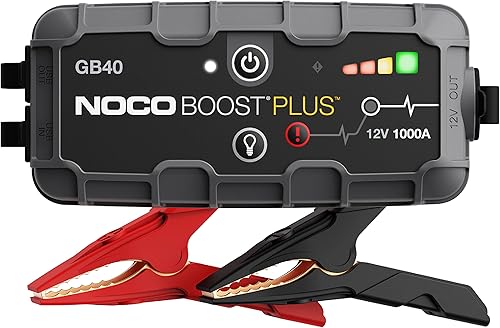
That covers a huge number of half-ton pickups and SUVs with gas V8s. It does not cover a big diesel. If you have a 6.7L Cummins or Power Stroke, buy something else on this list.
What you get for $99.95 is a 2.5 lb package that genuinely fits in a glovebox, patented spark-proof and reverse polarity protection, a 100-lumen LED with seven modes including SOS and strobe, and an integrated power bank for phones and tablets. It recharges in three hours. It's the one you'll actually keep in the vehicle instead of leaving in the garage, which counts for a lot.
How to choose
Match the engine rating, not the amp number. Peak amps are measured differently across brands and aren't comparable. The engine displacement rating is the manufacturer telling you what they'll stand behind. The NOCO GB40 says 6.0L gas and 3.0L diesel. WOLFBOX says under 10L. YaberAuto says up to 14L diesel, COSSIFTW up to 15L. Find your engine's displacement and shop from there.
Check whether you need 24V. Only the FlyAuto unit here explicitly supports both 12V and 24V. If you run commercial trucks or heavy equipment on a 24V system, that narrows the field to one.
Look at the cables. The JNC660's 46-inch #2 AWG cables are a real differentiator on trucks, where the battery may be awkwardly placed. The COSSIFTW uses 6AWG with EC8 clips. Thin, short cables are where budget packs lose current.
Ask whether it can wake a truly dead battery. Both the FlyAuto and YaberAuto units include a Force Start mode for batteries too flat for normal detection. The WOLFBOX has a one-touch boost for low-voltage starts. Without something like this, a deeply discharged battery can leave a lithium pack refusing to do anything.
Decide how much extra you want. The COSSIFTW's 200W AC inverter and the YaberAuto's 160PSI compressor are genuinely different value propositions. If you don't need them, spend less.
FAQ
Do I need 8000A to start a truck? Not necessarily. Peak amp figures aren't standardized between brands, and a 1700A unit with a 22Ah battery and #2 AWG cables like the JNC660 can outperform a higher-rated pack with thin cables. Use the manufacturer's engine displacement rating as your guide instead.
Will a lithium pack work in winter? It depends on the unit. WOLFBOX rates the MV24 for -4°F to 140°F, and YaberAuto quotes the same range for its 16-in-1. Other listings here don't state an operating temperature range, so check the spec before relying on a pack in genuine cold.
How often do I need to recharge one that just sits in the truck? YaberAuto quotes roughly 24 months of standby for its unit. COSSIFTW recommends charging every three months if the pack is unused. Treat quarterly top-ups as a reasonable habit regardless of brand — a jump starter that's flat when you need it is worse than useless.
Can these charge my phone too? Yes, all of the lithium packs here include USB output. The YaberAuto has two 18W USB-A ports on a 99.9Wh battery, the WOLFBOX has a 65W USB-C plus QC3.0 USB-A, the NOCO has an integrated power bank, and the COSSIFTW adds a 200W AC outlet on top of USB and DC.
Related guides
- Best car diagnostics, charging and accessories - OBD2 scanners, car battery jump starters, EV chargers and portable car battery chargers Requirements Explained
- Step-by-Step Best car diagnostics, charging and accessories - OBD2 scanners, car battery jump starters, EV chargers and portable car battery chargers Process
- Best Options for Best car diagnostics, charging and accessories - OBD2 scanners, car battery jump starters, EV chargers and portable car battery chargers
Key Takeaways
- Choosing the right best heavy duty jump starters trucks suvs means matching the key features to your specific needs and budget
- Read real customer reviews and check the return policy before you commit
- Compare value across models — the priciest option is not always the best fit