Comparison table
| Charger | Price | Max amps | Connector | Install | Cable length | Certifications |
|---|---|---|---|---|---|---|
| ChargePoint HomeFlex J1772 | Check price on Amazon | Not stated | J1772 | Hardwired, electrician | Not stated (cold-resistant) | UL |
| EVIQO 40A NEMA 14-50 | Check price on Amazon | 40A (50A circuit) | J1772 | Plug-in, NEMA 14-50 | Not stated | UL/ETL/FCC/Energy Star, IP66/NEMA-4 |
| EVIQO 48A Hardwired | Check price on Amazon | 48A (60A circuit); 50A via DIP on 70A | J1772 | Hardwired, electrician | Not stated | UL/ETL/FCC/Energy Star, IP66/NEMA-4 |
| ChargePoint HomeFlex NACS | Check price on Amazon | Not stated (20A–80A circuit) | NACS | Hardwired, electrician | Not stated (cold-resistant) | UL |
| NexCyber 48A | Check price on Amazon | 48A hardwired / 40A plug-in | J1772 | Either; pro install recommended | 25 ft | ETL, FCC, Energy Star |
| IYILO 48A | Check price on Amazon | 48A / 11.5kW (60A breaker) | NACS (J3400) | Hardwired, electrician | 25 ft | UL/ETL/Energy Star |
Quick answer: If you want the safest all-round pick with a real support network behind it, the ChargePoint HomeFlex (J1772 or NACS) is the one to beat. If you'd rather not pay for a hardwire job, the plug-in EVIQO 40A is the easy install, and the NexCyber 48A is the cheapest way to get maximum speed. Tesla and other NACS owners who want a native plug should look at the IYILO 48A.
Level 2 charging is one of the few EV upgrades that genuinely changes daily life — you stop planning trips around charging and just plug in when you get home. The catch is that most of these units look identical on a listing page, and the differences that matter (amperage, plug-in vs. hardwired, connector type, weather rating) are buried in the fine print. Here's how the main options actually differ.
ChargePoint HomeFlex Level 2 EV Charger J1772 — Best Overall
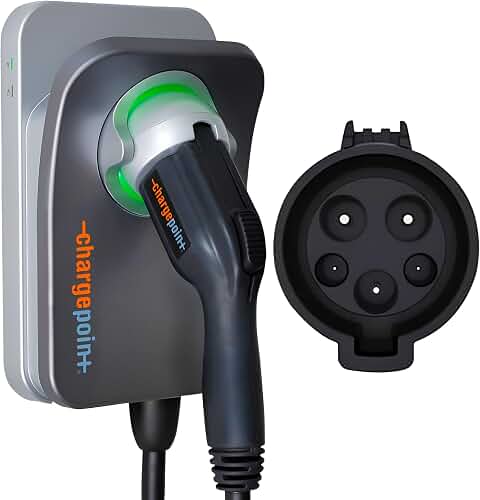
The ChargePoint HomeFlex Level 2 EV Charger J1772 is the hardwired J1772 version of the charger most people picture when they think "home EV charger." At $494 it's the priciest unit here, and the reason is largely what surrounds the hardware: ChargePoint runs a network of 274,000+ stations across North America and Europe plus 565,000+ roaming partner stations, and offers 24/7 support. That matters more than it sounds — when a charger stops talking to your Wi-Fi at 11pm, having a human to call is worth real money.
Finding the right best level 2 ev home chargers comes down to matching the features to how you will actually use it.
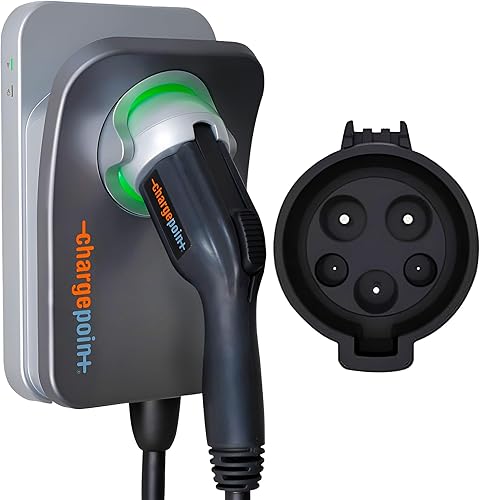
It's UL-certified, can be installed indoors or outdoors by an electrician, and ships with a cold-resistant cable, which is the spec to care about if you live somewhere that hits single digits. The ChargePoint mobile app handles scheduling, reminders, smart-home integration, station finding and charging data. Worth knowing up front: some of those app functions need Wi-Fi to work, and Wi-Fi is also part of the troubleshooting path if things go sideways.
Buy this if you want the least drama and don't mind paying a premium for it. Skip it if you're optimizing purely on cost per amp.
EVIQO Level 2 EV Charger J1772 40A NEMA 14-50 — Best for plug-in install without an electrician
The EVIQO Level 2 EV Charger J1772 40A NEMA 14-50 is the one to get if the phrase "licensed electrician" makes you wince. It's a wall-mounted plug-in unit that delivers a max 40A on a dedicated 50A/240V circuit — enough to fully recharge most EVs overnight.
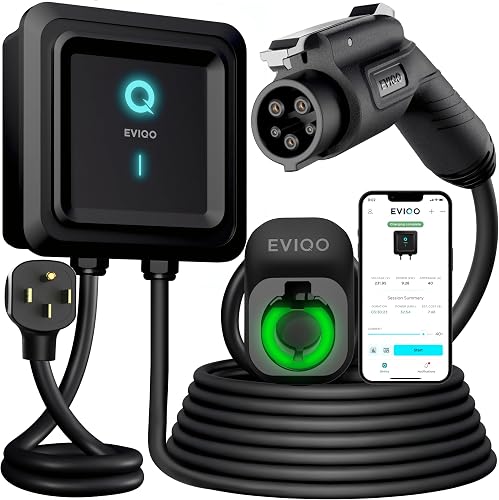
One critical caveat, and EVIQO says it plainly: it needs an EV-graded 4-prong NEMA 14-50 outlet, the same style as an RV or range outlet — not a dryer outlet. If you don't already have one, you're back to hiring an electrician anyway, so check your garage before you order.
It's UL/ETL/FCC/Energy Star certified in an IP66/NEMA-4 weatherproof enclosure, so rain, snow, heat and dust are covered, and the mainboard has steel shielding. The J1772 connector works with all North American EVs and PHEVs, and with a J1772-to-NACS adapter (not included) it'll serve a Tesla too. The app runs over 2.4 GHz Wi-Fi and lets you start/stop, set current from 6–40A, and track consumption and cost. The fluorescent holster is a small touch that's genuinely useful — 10 minutes of light exposure boosts brightness about 60%, so you can find the connector in a dark garage.
EVIQO Level 2 EV Charger J1772 48A — Best for maximum J1772 speed
At $428.99, the EVIQO Level 2 EV Charger J1772 48A is the hardwired sibling of the plug-in model above, and it's the pick if you want headroom. It puts out up to 48A on a dedicated 60A/240V circuit. There's also a DIP-switch trick — set positions 4 and 5 and you unlock 50A output, though that needs a dedicated 70A circuit, which is a serious ask of most residential panels.
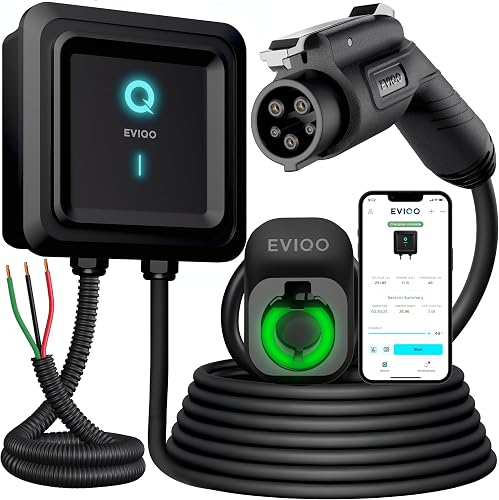
Hardwired means a licensed electrician is required per National Electrical Code. That's a few hundred dollars of install cost on top of the sticker price, so factor it in before you compare this against the plug-in version.
Everything else carries over: IP66/NEMA-4 weatherproofing, UL/ETL/FCC/Energy Star certification, steel-shielded mainboard, the rubberized J1772 connector with metal latch, app control over 2.4 GHz Wi-Fi with 6–48A adjustment, and the glow-in-the-dark holster. If your car can actually accept 48A, this is a sensible middle of the road between price and speed.
ChargePoint HomeFlex Hardwired NACS Charging Station — Best for Tesla owners who want network backing
The ChargePoint HomeFlex Level 2 EV Charger, Hardwired NACS Charging Station is the same $494 HomeFlex platform with a NACS connector instead of J1772 — no adapter needed for a Tesla. ChargePoint quotes charging 9× faster than a 120V outlet, delivering up to 45 mi/hr depending on your vehicle.
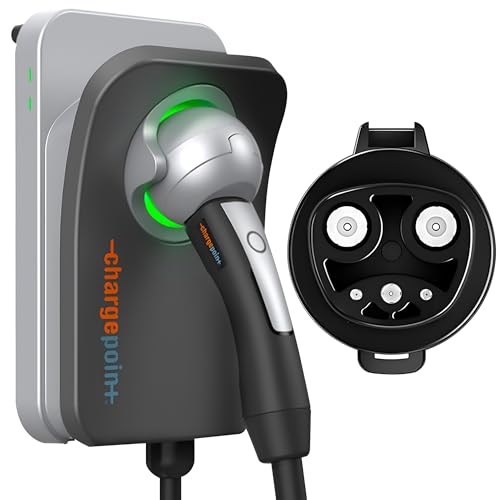
The install requirement here is unusually flexible: it accepts anywhere from a 20A to an 80A circuit, so if your panel is tight you can still run it, just slower. Same UL certification, same indoor/outdoor electrician install, same cold-resistant cable, same app and same 274k+/565k+ station network as the J1772 version.
If you drive a Tesla and want the network and support story rather than the cheapest box, this is your unit.
NexCyber Level 2 EV Charger 48A — Best budget pick
The NexCyber Level 2 EV Charger is the value play at $259.99 — roughly half the ChargePoint price for a charger that hits the same top amperage. Hardwired it does 48A for up to 46 miles/hour; through the NEMA 14-50 plug it runs 40A for up to 38 miles/hour. NexCyber recommends professional installation either way.
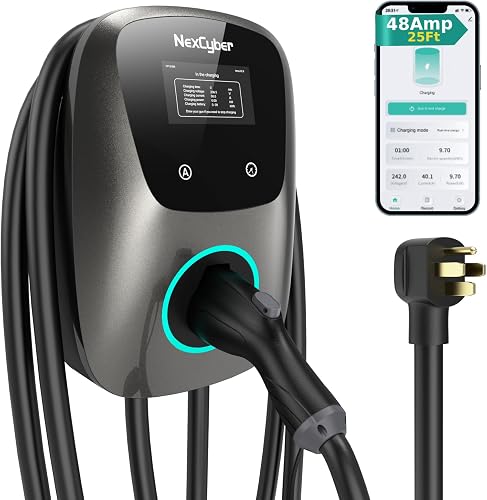
Wiring matters here and the listing is specific: no smaller than 8AWG for 40–48A, with 6AWG suggested (three 6AWG wires on the input side for 48A). Don't hand-wave this part.
The J1772 connector covers North American EVs and PHEVs — Ford, GM, Audi, Kia, Honda, Hyundai, Chevrolet Bolt, VW ID.4, Nissan Leaf, Mach-E, IONIQ 5 (2024 and earlier), BMW i3/i4/iX, Jeep Wrangler 4xe and more. Newer NACS cars like the Kia EV6 2025/EV9 and 2025 Ariya need a J1772-to-Tesla adapter.
The differentiator is that it's plug-and-play by default with a touch screen showing amperage, speed, input voltage and delay time — no app required. Set amperage anywhere from 16A to 48A on the screen. The Wi-Fi app is optional and adds cost tracking, history, full-charge notifications and off-peak scheduling. ETL, FCC and Energy Star certified with a 3-year warranty, and it ships with a 25ft cable.
IYILO Level 2 EV Charger for Tesla 48Amp — Best for NACS with overheat protection
The IYILO Level 2 EV Charger for Tesla is $379.97 with a native NACS (J3400) connector and a 25ft heavy-duty cable, delivering up to 46 miles of range per hour at 48A (11.5kW). Hardwired install, 60A breaker, licensed electrician. Current adjusts in 1A increments from 6A to 48A, which is finer control than most.
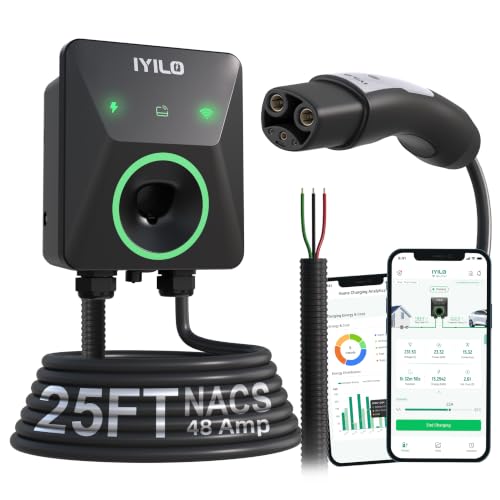
The standout spec is thermal safety: an NTC temperature sensor sits inside the connector itself, streaming live temperature to the app. Above 221°F (105°C) the charger automatically throttles power or shuts off. Connector overheating is a real failure mode in high-amperage home charging, so hardware-level protection is a genuine feature, not marketing.
IYILO is also listed on several utility EV charging program portals — ComEd, PSEG (NJ), PSEG-LI, Seattle City Light, Salt River Project, Portland General Electric, Oregon DOT and Georgia Power among others — which can mean rebate eligibility depending on where you live. Check your utility's list before buying; that can swing the real cost meaningfully.
The app handles Time-of-Use rates, energy and cost tracking, multiple user accounts, scheduled charging, RFID cards and OTA updates. It's 2.4GHz Wi-Fi only. J1772 cars need an adapter, not included.
How to choose
Connector first, everything else second. Get the plug your car actually uses. J1772 covers most non-Tesla EVs and PHEVs; NACS is Tesla and the newer wave of cars adopting the standard. Adapters exist in both directions but none of these chargers include one, and an adapter is one more thing dangling in the weather.
Plug-in vs. hardwired is really a question about your panel. Plug-in only saves you money if you already have a NEMA 14-50 outlet on a dedicated circuit. If you don't, you're paying an electrician either way — at which point hardwiring usually gets you more amps for the same labor. Note that the NexCyber can do either.
Amperage is capped by your car, not the charger. A 48A charger won't charge a vehicle whose onboard charger tops out at 32A any faster than a 40A unit would. Look up your car's max AC acceptance rate before paying for headroom you can't use. And every step up in amperage needs a bigger breaker: 40A wants a 50A circuit, 48A wants 60A, and the EVIQO's 50A mode wants 70A — which many older panels simply can't spare without a service upgrade.
Weather rating matters if the unit lives outside. IP66/NEMA-4 on the EVIQO units is an explicit rain, snow, heat and dust rating. ChargePoint states indoor or outdoor installation and a cold-resistant cable. Match the spec to where the box will actually hang.
App vs. no app. The ChargePoint and EVIQO units lean on their apps, and EVIQO, IYILO and NexCyber all require 2.4GHz Wi-Fi. If your garage Wi-Fi is weak, the NexCyber's plug-and-play touchscreen default means you can ignore connectivity entirely and still schedule charging.
Rebates. Check your utility's approved-charger list before you buy — IYILO explicitly lists program participation with ComEd, PSEG, Seattle City Light, Salt River Project, Portland General Electric and Georgia Power, among others. A rebate can outweigh a $100 price difference.
Before you commit, read through recent buyer reviews on the listing for whichever model you're leaning toward — app reliability and long-term durability are exactly the things that show up there and nowhere on a spec sheet.
FAQ
How much faster is Level 2 than a regular outlet? ChargePoint states its HomeFlex NACS unit charges 9× faster than a 120V outlet, delivering up to 45 mi/hr depending on the vehicle. NexCyber quotes up to 46 miles/hour hardwired at 48A, and IYILO quotes up to 46 miles of range per hour at 48A. In practice, that's the difference between a full overnight charge and a three-day trickle.
Can I plug a Level 2 charger into my dryer outlet? No. EVIQO's plug-in model specifically requires an EV-graded 4-prong NEMA 14-50 outlet — the RV/range style — and calls out that a dryer outlet is not the same thing. Different plug, different circuit rating.
Do I need an electrician? For every hardwired unit here — the ChargePoint HomeFlex J1772 and NACS models, the EVIQO 48A, and the IYILO — yes, and EVIQO notes that's per National Electrical Code. The EVIQO 40A plug-in doesn't need one if you already have the correct outlet. NexCyber recommends professional installation for both of its modes.
Which one is the fastest? The EVIQO 48A hardwired can be set to 50A output via DIP switches, though that requires a dedicated 70A circuit. Among standard configurations, the EVIQO 48A, NexCyber 48A and IYILO 48A all top out at 48A. Your car's onboard charger will likely be the real limit.
Related guides
- How to Lower Your Best car diagnostics, charging and accessories - OBD2 scanners, car battery jump starters, EV chargers and portable car battery chargers Costs
- Best car diagnostics, charging and accessories - OBD2 scanners, car battery jump starters, EV chargers and portable car battery chargers Requirements Explained
- How Voltmere Researches Products
Key Takeaways
- Choosing the right best level 2 ev home chargers means matching the key features to your specific needs and budget
- Read real customer reviews and check the return policy before you commit
- Compare value across models — the priciest option is not always the best fit