Comparison table
| Product | Price | Peak amps | Engine rating | Air compressor | Light | Weight |
|---|---|---|---|---|---|---|
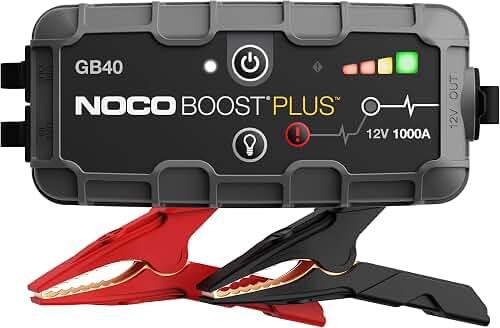
| NOCO Boost GB40 | Check price on Amazon | 1000A | 6.0L gas / 3.0L diesel | No | 100 lumens, 7 modes | 2.5 lb |
| GOOLOO A3 | Check price on Amazon | 3000A | 9.0L gas / 6.5L diesel | Yes, 150 PSI / 35L/min | Yes (lumens Not stated) | Not stated |
| YaberAuto 5000A | Check price on Amazon | 5000A | 9.0L gas / 8.0L diesel | Yes, 150 PSI / 35L/min | 800 lumens, 4 modes | Not stated |
| JOLTEKON 4500A | Check price on Amazon | 4500A | 9.0L gas / 8.0L diesel | Yes, 150 PSI | 500 lumens, 4 modes | Not stated |
| TREKURE TK60 | Check price on Amazon | 5000A | 10L gas / 8L diesel | No | 2000 lumens, magnetic panel | 0.8 lb |
| BIUBLE Booster Pack | Check price on Amazon | 5000A | 7.0L gas / 5.5L diesel | No | 3 modes (lumens Not stated) | Not stated |
Quick answer: If you just want the safest, most proven pocket jumper for a normal car, the NOCO Boost GB40 12V 1000A UltraSafe Portable Lithium Jump Starter is the default pick. If you'd rather have one box that also fills your tires, the GOOLOO A3 12V 3000A Portable Jump Starter with Air Compressor does both for less. And if you're buying a glovebox insurance policy on a budget, the BIUBLE Jump Starter Car Jump Starter Auto Battery Booster Pack 5000A Peak 12V covers most engines for under thirty bucks.
A portable jump starter is one of those purchases where the spec sheet lies to you a little. Peak amps get printed in huge numbers on the box, but what actually matters is whether the unit will start your engine, whether it survives two years of temperature swings in a glovebox, and whether it does anything else useful the other 364 days a year. Below are six options that cover the realistic range, from a $29.99 backup to a $99.99 do-everything kit.
NOCO Boost GB40 — Best Overall
The GB40 is the one most people should buy, and it's not because it has the biggest number on the label — it has the smallest. 1000 amps of peak lithium power, rated for engines up to 6.0L gas and 3.0L diesel. That covers virtually every sedan, crossover, and half-ton truck on the road.
Finding the right best portable jump starters cars comes down to matching the features to how you will actually use it.
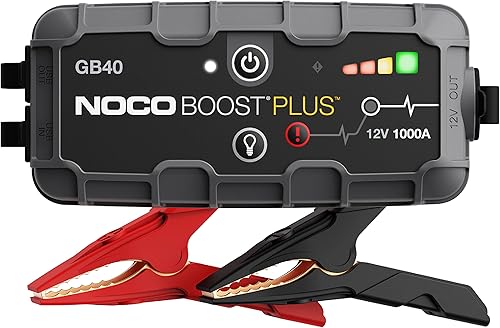
What you're paying $99.95 for is the engineering around that number. NOCO's UltraSafe design uses patented spark-proof and reverse polarity protection, so clamping onto a 12V battery the wrong way doesn't produce a bang or a ruined unit. That matters more than you'd think at 6am in a parking lot when you're half-awake.
It claims up to 20 starts per charge, recharges in 3 hours, and weighs 2.5 lb — heavier than the pocket units here, but still glovebox-sized. There's an integrated power bank for phones and tablets, plus a 100-lumen LED with 7 modes including SOS and strobe.
The honest tradeoff: 1000A won't force-start a battery sitting at true 0V the way some of the cheaper units on this list advertise, and 100 lumens is the dimmest light here. You're buying reliability and safety margin, not features.
NOCO Boost GB40 12V 1000A UltraSafe Portable Lithium Jump Starter
GOOLOO A3 12V 3000A — Best for Tire Inflation Too
Flat tires are more common than dead batteries, and the A3 is the smartest value play on this list because it handles both for $69.99.
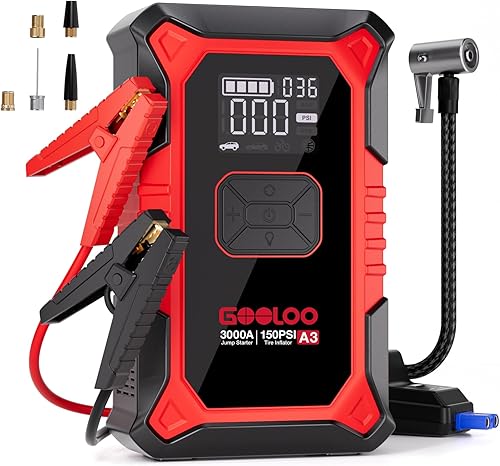
The jump side is rated to 9.0L gas and 6.5L diesel at 3000A, with a BOOST button that force-starts a battery whose voltage has dropped too low for a normal handshake. It's rated for 1000+ charge cycles and operation from -4°F to 140°F.
The compressor is the real story. 150 PSI max, 35L/min airflow, 5 inflation modes with 5 nozzles, and a claimed 45 minutes of continuous cordless inflation on a full charge. GOOLOO cites taking a Tesla Model 3/Y tire from 30 to 36 PSI in about a minute. Auto shut-off and tire pressure detection mean you set the target and walk away, and the display is built to stay readable in direct sun.
GOOLOO counts it as 7-in-1: jump starter, tire inflator, power bank, LED flashlight, bike pump, ball pump, and digital pressure gauge. Ten protections including short circuit, overcurrent, reverse connection, overheating, and overcharge.
GOOLOO A3 12V 3000A Portable Jump Starter with Air Compressor
YaberAuto 5000A 150PSI Jump Starter with Air Compressor — Best Fully Loaded Kit
If the GOOLOO is the value multitool, the YaberAuto is the maxed-out version at $99.99. Nine functions: jump starter, tire pump, pressure gauge, power bank, flashlight, SOS, white strobe, red strobe warning light, and — unusually — a pair of 400V insulated safety gloves in the box.
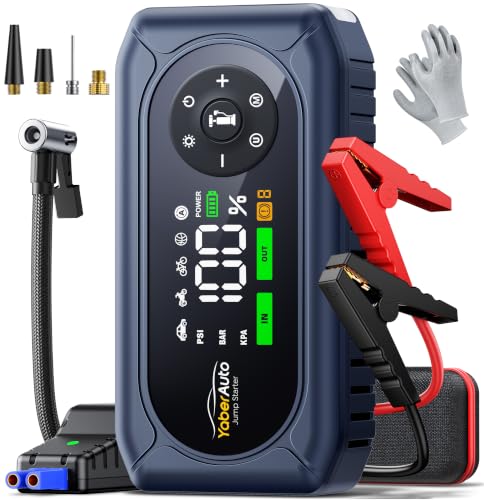
Jump rating is 5000A peak, 9.0L gas and 8.0L diesel, with a Force Start function for completely drained or low-voltage batteries, working from -4°F to 140°F. Standby is quoted at around 24 months with 1000+ cycles.
The compressor matches the GOOLOO's 150 PSI and 35L/min but adds a larger 3.3-inch screen, ±1 PSI accuracy, smart presets, auto memory, and a detachable hose. The light is the brightest here at 800 lumens across 4 modes, and USB-C handles fast charging with 18W output.
Ten safety protections, a V0-rated fireproof battery, and a shell built to shrug off rain, dust, and drops. The gloves feel like a gimmick until you're working near a battery terminal in the rain.
JOLTEKON Car Battery Jump Starter with Air Compressor 4500A — Best for Cold-Weather Range
The JOLTEKON sits at the same $99.99 price with a nearly identical 8-in-1 feature set, and the reason to pick it over the YaberAuto comes down to one line in the spec sheet: it's rated from -20℃ to 60℃, the widest stated cold tolerance in this group. If you live somewhere that genuinely hits -4°F and stays there, that's the number to care about.
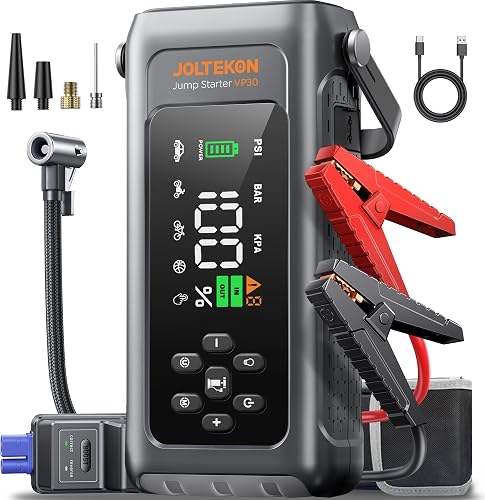
4500A peak with a Force Start function for completely drained batteries, rated for 9.0L gas and 8.0L diesel, 24-month standby, 1000+ recharge cycles.
The compressor runs a 19-cylinder motor to 150 PSI with 5 modes, 4 nozzles, 3 units, auto memory, and automatic shut-off, and it'll take a tire to 25 PSI in a few minutes. The 500-lumen wide light is described as over 400% brighter than the previous design, with white flashlight, white strobe, red strobe warning, and SOS modes. The 3.3" smart display reports true remaining battery level rather than a vague three-bar guess — genuinely useful for a device that sits unused for months.
TREKURE Car Battery Jumper Starter Portable 5000A — Best Compact Pick
At 0.8 lb, the TREKURE TK60 is the lightest thing here by a wide margin — pocket-sized, with a quick-release rubber carry loop and a detachable lanyard. Yet it's rated for 10L gas and 8L diesel engines at 5000A peak, the highest engine ceiling on this list, with Force Start tech built into the smart clamps for batteries sitting at 0V.
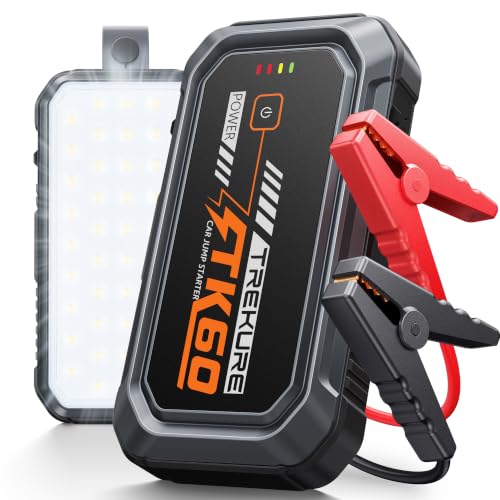
The standout feature is the light. Instead of a torch-style beam, it's a full-panel magnetic LED that clings to metal under your hood for hands-free work, rated at 2000 lumens with lighting, strobe, red strobe, and SOS modes. Anyone who's tried to hold a flashlight in their teeth while changing a tire will understand the appeal.
Internally it uses four thinner high-capacity battery packs so it doubles as a phone power bank. Safety covers V0-rated flame retardant materials, a reinforced shockproof casing, and 10 protections including reverse polarity, spark-proof, short-circuit, overvoltage, overheating, and temperature.
At $49.99 it's the value sweet spot if you don't need a compressor.
BIUBLE Jump Starter Auto Battery Booster Pack 5000A — Best Budget Buy
At $29.99, the BIUBLE is the cheapest way to stop being the person who needs a stranger's cables. 5000A peak, rated for gasoline engines up to 7.0L and diesel up to 5.5L, with a claimed 40 jump starts per charge and operation from -4°F to 140°F. It'll handle cars, trucks, motorcycles, boats, RVs, tractors, ATVs, UTVs, lawnmowers, and snowmobiles.
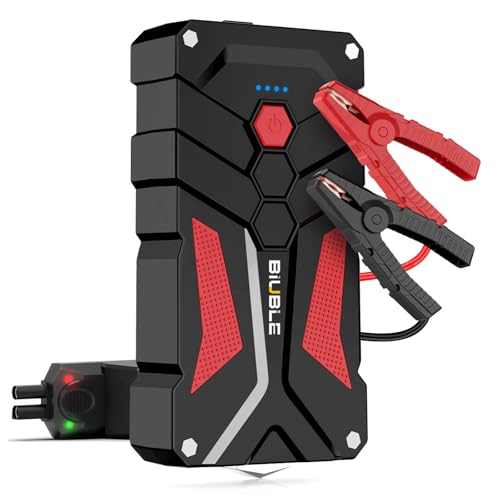
Two USB outputs (5V/3A and 5V/2.4A) turn it into a power bank, and there's a 3-mode LED flashlight. Eight protections cover spark-proof, reverse polarity, over-current, high-temperature, and overload, with an audible buzzer plus flashing lights if you connect it wrong. Hardened plastic and rubber corners handle the abuse of living in a trunk. BIUBLE includes a 2-year warranty and technical support.
What you give up: no compressor, no big display, and a lower diesel rating than everything else here. For a commuter car, that's fine.
How to choose a portable jump starter
Match the engine rating, not the amp number. Peak amps are measured differently by different brands and aren't directly comparable across manufacturers. The engine displacement rating is the more useful figure. The NOCO GB40 tops out at 6.0L gas / 3.0L diesel with only 1000A, while the BIUBLE claims 7.0L gas at 5000A — that gap tells you the amp figures aren't measured the same way. Find your engine size and buy a unit that clears it with room to spare.
Decide whether you want a compressor. This is the real fork in the road. The GOOLOO A3, YaberAuto, and JOLTEKON all include 150 PSI inflators; the NOCO, TREKURE, and BIUBLE don't. A compressor makes the unit bigger and heavier but replaces a separate tool. If your tires slowly lose pressure every winter, it pays for itself in convenience.
Look for a Force Start or Boost function. A truly dead battery at or near 0V won't trigger the safety handshake on many jump starters, and the unit will simply refuse to fire. The TREKURE, GOOLOO A3, YaberAuto, and JOLTEKON all list a force-start override for exactly this scenario. The NOCO doesn't advertise one — it leans on its UltraSafe protection design instead.
Check cold-temperature rating if you live somewhere cold. The TREKURE, GOOLOO A3, YaberAuto, and BIUBLE all quote -4°F to 140°F. The JOLTEKON quotes -20℃ to 60℃, which is the same bottom end expressed differently but stated with a slightly wider top. Batteries die in cold weather, so the device needs to work in the same conditions that killed your battery.
Weight and size decide whether you actually carry it. A 0.8 lb TREKURE lives in a glovebox forever without you thinking about it. A 2.5 lb NOCO fits too but you'll notice. Anything with a compressor is trunk-sized.
Standby time matters more than starts-per-charge. You'll use this thing once every couple of years. The TREKURE, YaberAuto, and JOLTEKON quote roughly 24 months of standby; that's the number that determines whether it works when you finally need it. Whatever you buy, top it up every six months.
Before you commit, go read the recent owner reviews on the listing itself — especially for the cheaper units, where build quality and long-term charge retention are the things buyers tend to comment on directly.
FAQ
What's the best portable jump starter overall? For most drivers, the NOCO Boost GB40 — its 6.0L gas / 3.0L diesel rating covers the overwhelming majority of passenger vehicles, and its patented spark-proof and reverse polarity protection make a wrong connection a non-event. If you want more capability per dollar, the GOOLOO A3 adds a 150 PSI compressor and a higher 9.0L engine rating for $30 less.
Can a portable jump starter start a completely dead battery? Sometimes, but only if it has a force-start override. A battery at 0V can't complete the safety handshake most units require. The TREKURE's Force Start is built into its smart clamps, the GOOLOO A3 uses a BOOST button, and the YaberAuto and JOLTEKON both list Force Start functions for drained or low-voltage batteries.
How often do I need to recharge it? Treat it like a smoke detector battery — check it on a schedule. The TREKURE, YaberAuto, and JOLTEKON quote roughly 24-month standby, so twice a year is a safe cadence. The NOCO GB40 fully recharges in about 3 hours. Units with a percentage display, like the JOLTEKON's 3.3" screen, make this check take five seconds.
Are the tire inflator models worth the extra bulk? If you drive on rough roads or your tires lose pressure seasonally, yes. The GOOLOO A3 claims a Tesla Model 3/Y tire from 30 to 36 PSI in about a minute and up to 45 minutes of continuous inflation per charge, which is enough for several tires. If you already own a compressor, skip it and buy the smaller TREKURE or the NOCO instead.
Related guides
- Comparing Your Best car diagnostics, charging and accessories - OBD2 scanners, car battery jump starters, EV chargers and portable car battery chargers Options
- Editorial Policy: How Voltmere Researches and Reviews Products
- Best car diagnostics, charging and accessories - OBD2 scanners, car battery jump starters, EV chargers and portable car battery chargers with Past Challenges
Key Takeaways
- Choosing the right best portable jump starters cars means matching the key features to your specific needs and budget
- Read real customer reviews and check the return policy before you commit
- Compare value across models — the priciest option is not always the best fit