Specifications
| Product | Peak amps | Engine rating | Air compressor | Light | Price |
|---|---|---|---|---|---|
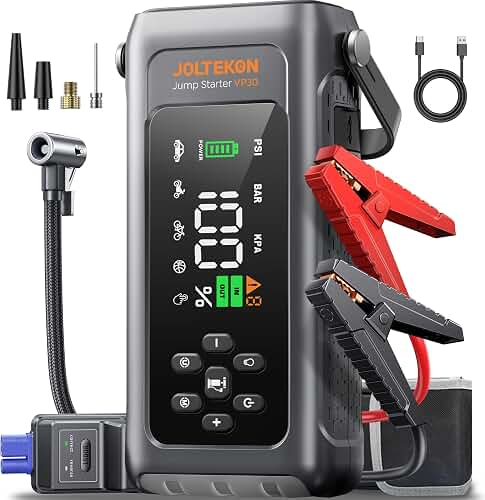
| JOLTEKON 4500A with Air Compressor | 4500A | 9L gas / 8L diesel | 150PSI, 19-cylinder, 5 modes | 500 lumens, 4 modes | Check price on Amazon |
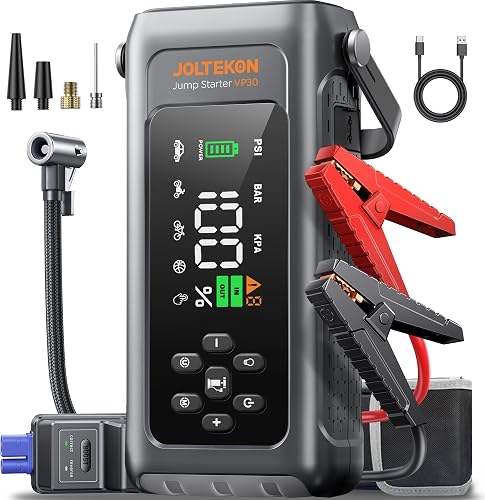
| TREKURE 5000A TK60 | 5000A | 10L gas / 8L diesel | None | 2000LM magnetic full-panel | Check price on Amazon |
| YaberAuto 5000A 150PSI | 5000A | 9L gas / 8L diesel | 150PSI, 35L/min | 800 lumens, 4 modes | Check price on Amazon |
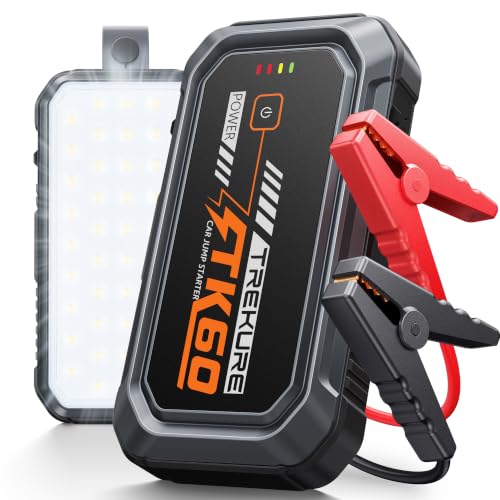
| WOLFBOX MV24 4000A | 4000A | 10L gas / 10L diesel | None | LED, SOS/strobe/high beam | Check price on Amazon |
| AstroAI S8 Air | 3000A | 9L gas / 6.5L diesel | 150PSI, 25L/min | Not stated | Check price on Amazon |
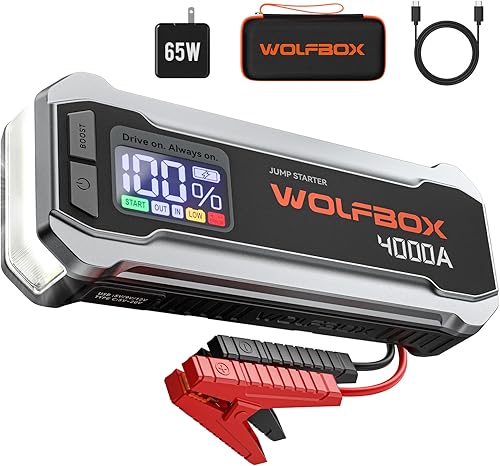
| Joltekon 6000A with Air Compressor | 6000A | All gas / 10L diesel | 150PSI, 45L/min, 22-cylinder | LED, 3 modes | Check price on Amazon |
Quick answer: A portable jump starter doesn't really "charge" a car battery — it dumps a short, huge burst of current into the battery so the starter motor can crank, and then your alternator does the actual recharging as you drive. To use one safely, connect red to positive, black to negative, power the pack on, wait for the green/ready signal, crank for 3 seconds max, and then drive for 20–30 minutes without shutting off. If your battery is genuinely dead-dead rather than just drained, you want a plug-in trickle charger, not one of these packs.
What a portable jump starter actually does
This is the confusion that trips most people up. A portable "car battery charger" of the type sold as a jump box holds a lithium pack in the 37–88.8Wh range. That is a tiny amount of energy compared to a car battery's ~600Wh. It cannot refill your battery. What it can do is deliver a massive short-duration current spike — the peak amperage numbers you see advertised, from 3000A to 6000A — so the starter motor spins even though the battery is flat.
Once the engine catches, the alternator takes over and recharges the battery. That's why the "drive for 20–30 minutes afterward" step isn't optional advice; it's the actual charging part of the procedure.
Finding the right how to charge car battery with portable charger comes down to matching the features to how you will actually use it.
The safe procedure, step by step
- Turn the ignition off. Everything off — headlights, HVAC, radio, phone chargers.
- Check the pack has charge. Most of these units have a display for exactly this reason. The AstroAI S8 has a 2.4" screen; the Joltekon and YaberAuto units use a 3.3" display.
- Red clamp to the positive terminal (+), black clamp to the negative terminal (−) or to a bare metal ground point on the engine block. Get a solid bite on clean metal, not on corrosion.
- Wait for the ready indicator. Modern packs with reverse-polarity and spark protection won't pass current until the connection is correct. If you get a fault beep, stop and re-check the clamps — do not force it.
- If the battery reads 0V, engage the Force Start / Boost function. This bypasses the safety check that normally refuses to fire into a battery it can't detect. Only use it after confirming your clamps are on the right terminals, because the polarity protection is what you just overrode.
- Crank for no more than 3 seconds. If it doesn't start, wait 30 seconds and try again. Repeated long cranks cook the starter and heat the pack.
- Disconnect black first, then red. Then drive. Don't switch the engine off at the first gas station.
Capacity is only stated for two: the WOLFBOX MV24 at 88.8Wh and the Joltekon 6000A at 37Wh. Standby time is stated at about 24 months for the JOLTEKON 4500A, the YaberAuto and the Joltekon 6000A.
Who this approach is for
You're the right customer for a portable jump pack if you park outside, drive an older car, live somewhere that gets properly cold, or simply want to stop needing a second car and a stranger's goodwill to get moving. The whole appeal is that you handle it alone, in the dark, in a parking garage, in about four minutes.
It also makes sense if your battery is fine but occasionally gets drained by something stupid — an interior light left on, a door not quite shut. That's a battery that will recover perfectly well on alternator charge once it's running.
Who should skip it
Skip a jump pack if your battery is failing rather than flat. A battery that dies again within a day or two, or that needs a jump every cold morning, is a battery that has lost capacity. You need a replacement or a proper multi-stage plug-in charger, and a jump box will just keep bailing you out of a problem that's getting worse.
Skip it too if you never drive far enough to recharge. If your commute is six minutes, the alternator won't recover what the start consumed, and you'll be in a slow-motion decline. Use a mains charger overnight instead.
And if you drive a heavy diesel, check the engine rating against your actual displacement before assuming any of these covers you — the AstroAI S8 Air is rated to 6.5L diesel, while the WOLFBOX MV24 and Joltekon 6000A go to 10L.
Honest trade-offs
Peak amps are the least standardized number in this category. There's no enforced test method behind them, so a 6000A claim from one brand and a 4000A claim from another aren't strictly comparable. The engine displacement rating is the more useful spec, and even that is a manufacturer's claim.
Air compressors add real bulk. The units that include one — JOLTEKON 4500A, YaberAuto, AstroAI S8 Air, Joltekon 6000A — are meaningfully larger than a bare jump pack. The TREKURE TK60 is listed at 0.8 lbs, which is glovebox territory. That's the trade: one tool that handles two roadside failures, or one tool small enough that you actually keep it in the car.
Lithium packs self-discharge. Even with 24-month standby claims, a pack you toss in the trunk and forget about for two years may not have what you need. Set a reminder to top it off twice a year.
Heat is real. The AstroAI listing explicitly warns the air tube gets hot after inflation and to let it cool before removing, and to rest the compressor 10 minutes after 10 minutes of continuous use. Cheap compressors that don't say this still behave the same way.
What to check on the listing before you buy
- Current price. Everything in this category moves constantly. The prices here are a snapshot, and the number you see today is the one that matters.
- Variant. Several of these ship in multiple configurations — with or without the compressor, with or without accessories. The AstroAI S8 Air is listed in Orange; the YaberAuto bundle includes 400V insulated gloves. Confirm the variant in your cart is the one you read about.
- Warranty and support. Terms vary by seller and aren't always on the main product page. Check the manufacturer section of the listing.
- Reviews. Read them yourself, and specifically filter for reviews from cold climates and from people reporting on the unit after 12+ months. That's where these products either hold up or don't.
JOLTEKON Car Battery Jump Starter with Air Compressor 4500A 150PSI, Car Jumper Starter Portable (9L Gas/8L Diesel), Jump Box Car Battery with Auto-Shutoff Tire Inflator, Jumper Cables and Light — consider instead if…
…you want the flat-tire problem solved in the same box. The JOLTEKON Car Battery Jump Starter with Air Compressor 4500A 150PSI combines eight functions including the 150PSI inflator, a 500-lumen light with SOS and red strobe modes, and a Force Start function for fully drained batteries. It's rated from -20℃ to 60℃ and claims 1000+ recharge cycles.
TREKURE Car Battery Jumper Starter Portable 5000A, Portable Car Jump Starter up to 10L Gas or 8L Diesel Engine, Jump Box, Jumper Cables for Car Battery, Magnetic Build, 2000LM Flashlight, Power Bank — consider instead if…
…size and price matter more than extra functions. At 0.8 lbs and $49.99, the TREKURE Car Battery Jumper Starter Portable 5000A is the one you'd actually keep in a glovebox. The magnetic full-panel LED that sticks to the underside of your hood is a genuinely thoughtful touch for hands-free work.
WOLFBOX 4000A Jump Starter,12V Car Battery Jumper Starter Portable with 65W Quick Charger,LED Display,88.8Wh Booster Jump Box Pack (10L Gas 10L Diesel Engine) with LED Light,Jumper Cables, MV24 — consider instead if…
…you want the pack to double as a serious power bank. The WOLFBOX 4000A MV24 has the largest stated capacity here at 88.8Wh, a 65W USB-C in/out port that refills the unit in 1.3 hours, and an IP64 rating. It's also the only one listing UL, FCC, CE and CA65 testing plus a 10L diesel rating.
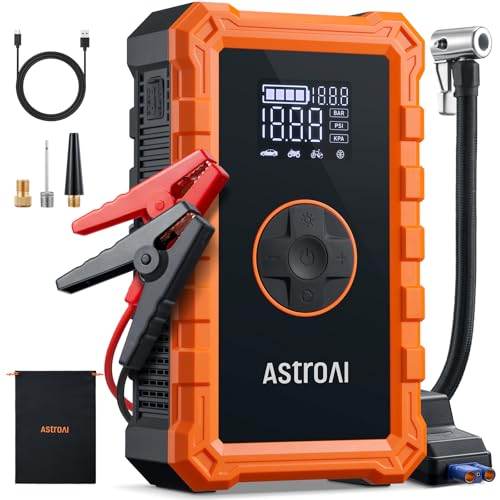
AstroAI S8 Air Jump Starter with Air Compressor, 3000A Peak Car Battery Jump Starter Portable (9.0 Gas/6.5L Diesel) with 150PSI Cordless Auto-Shutoff Tire Inflator, 12V Battery Charger Booster(Orange) — consider instead if…
…you want a compressor without paying near $100. The AstroAI S8 Air Jump Starter is $59.98, claims up to 20 starts per charge, and stores its cord and accessories internally so nothing goes missing in the trunk. The 6.5L diesel ceiling is the limitation to check against your engine.
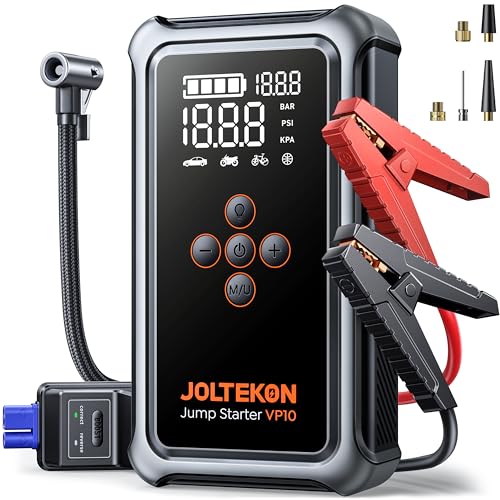
Joltekon Car Battery Jump Starter with Air Compressor 6000A 150PSI, Car Jumper Starter Portable (All Gas/10L Diesel), Jump Box Car Battery with Auto-Shutoff Tire Inflator, Jumper Cables and Light — consider instead if…
…you drive something big or want the fastest inflation. The Joltekon 6000A 150PSI is rated for all gas engines and 10L diesel, and its 22-cylinder motor moves 45L/min — the highest airflow of the group. Note the stated 37Wh capacity is modest, so treat it as a starter first and a phone charger second.
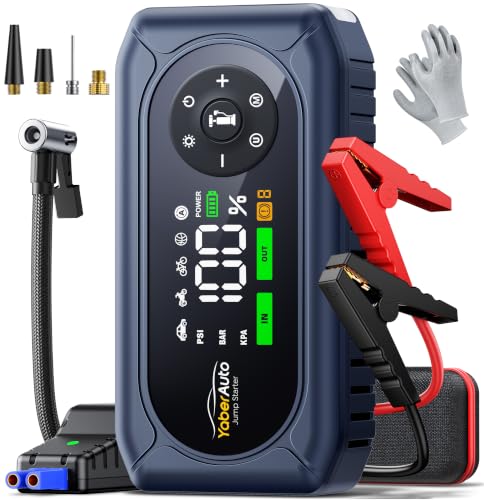
YaberAuto 5000A 150PSI Car Battery Jump Starter with Air Compressor & Gloves, Car Jumper Starter Portable with Tire Inflator, 12V Jump Box (9L Gas/8L Diesel) Jumper Cables, 18W Fast Charge 800LM Light — consider instead if…
…you'd rather not buy safety gear separately. The YaberAuto 5000A 150PSI Jump Starter bundles 400V insulated gloves with a 9-function kit, 800-lumen light, 35L/min inflation and a V0-rated fireproof cell with 10 protections.
FAQ
Can I leave the pack connected to charge the battery over time? No. These aren't designed for that and won't accomplish it — the pack's stored energy is a fraction of a car battery's. Connect, start, disconnect, drive.
What if the car doesn't start on the first try? Wait 30 seconds and try once more, cranking no longer than 3 seconds. If it fails three times, the problem probably isn't the battery — think starter, fuel, or a bad ground. Repeatedly hammering it makes things worse.
Is Force Start safe? It's safe when your clamps are correct, because all it does is bypass the detection step that a 0V battery can't satisfy. It is not safe if your clamps are reversed, since that detection is also what protects you. Look before you press it.
How often should I top up the jump pack? Every six months is a reasonable habit even on units claiming ~24-month standby, because cold and heat both accelerate self-discharge. A pack at 20% when you need it is nearly as useless as no pack.
Related guides
- Best car diagnostics, charging and accessories - OBD2 scanners, car battery jump starters, EV chargers and portable car battery chargers for Seniors
- Best car diagnostics, charging and accessories - OBD2 scanners, car battery jump starters, EV chargers and portable car battery chargers Requirements Explained
- FAQ: Best car diagnostics, charging and accessories - OBD2 scanners, car battery jump starters, EV chargers and portable car battery chargers
Key Takeaways
- Choosing the right how to charge car battery with portable charger means matching the key features to your specific needs and budget
- Read real customer reviews and check the return policy before you commit
- Compare value across models — the priciest option is not always the best fit