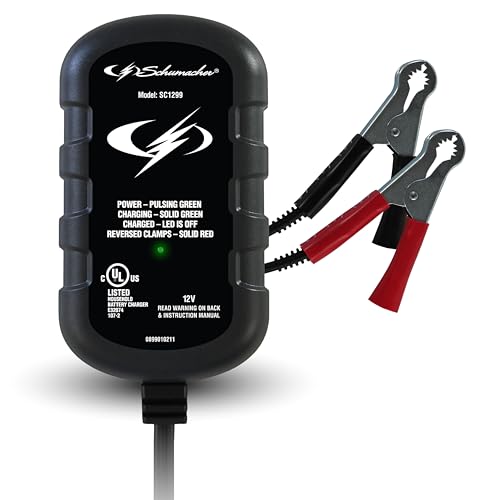
Spec and compatibility table
| Product | Price | Output | Battery types | Notable |
|---|---|---|---|---|
| Schumacher Electric 0.8A Car Battery Charger & Maintainer, 12V – SC1299 | Check price on Amazon | 0.8A, 12V | Standard, AGM, gel | Reverse polarity protection; gas and diesel vehicles |
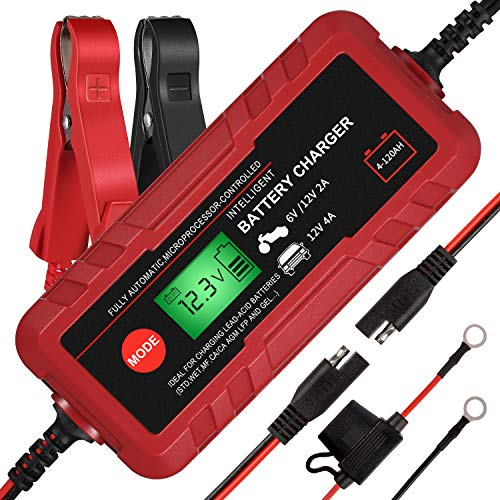
| Adakiit 4A Smart Car Battery Charger, 6V 12V Automotive Charger Maintainer | Check price on Amazon | 4A, 6V/12V | Pb/SLA/VRLA/GEL/AGM, 4–120Ah | 8-stage charging with desulfation and recondition; LCD showing voltage, current, mode, % |
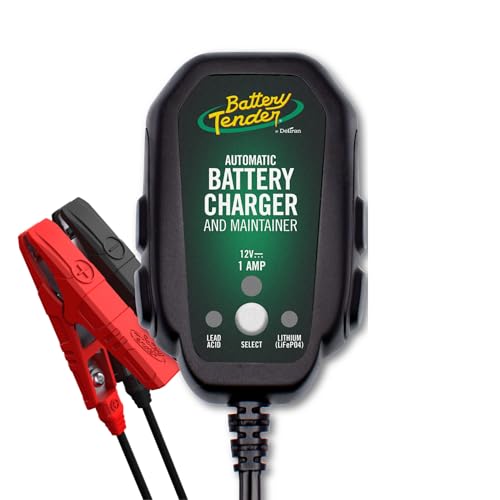
| Battery Tender Junior 12V, 800mA Battery Charger and Maintainer for Lead Acid and Lithium Batteries - Switchable Battery Charger for Powersports - 022-0199-DL-WH | Check price on Amazon | 800mA, 12V | AGM, flooded, gel, lithium (LiFePO4) | Switchable chemistry; spark-proof connection; 5-year warranty |
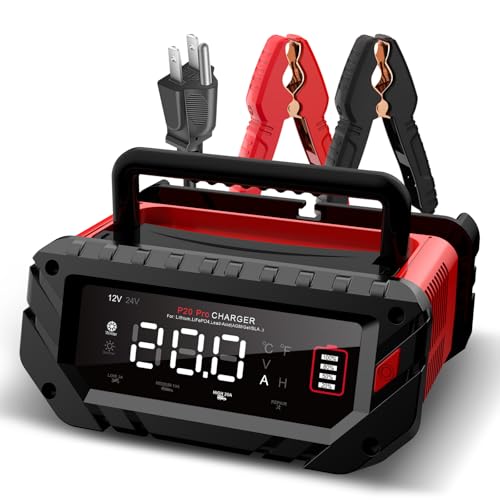
| 20A Car Battery Charger, 12V/24V Smart Battery Maintainer, Trickle Chargers | Check price on Amazon | 12V up to 20A / 24V up to 10A | Lead-acid (AGM, Gel, SLA, Flooded, VRLA, EFB, MF, WET), Lithium, LiFePo4 | Auto voltage detection; three current modes; built-in cooling fan |
| Phefop 2L Car Battery Filler, Double Action Anti Drip Auto Shutoff Deep Cycle Battery Water Filling Bottle for Car Maintenance Equipment | Check price on Amazon | Not applicable | Serviceable (capped) batteries | 2L capacity; auto shutoff; PP/PE construction |
| Phefop 2L Car Battery Filler, Batteries Drip Auto Shutoff Deep Cycle Battery Water Filling Bottle for Car Maintenance Equipment 2L Filler, Double Action Anti Water | Check price on Amazon | Not applicable | Serviceable (capped) batteries | 2L capacity; auto shutoff; anti-drip valve tip |
Quick answer: Most car batteries die early from chronic undercharging, not old age — short trips never replace what starting the engine pulls out, and a battery that sits below full charge sulfates its plates permanently. The two habits that matter most are keeping the terminals clean and keeping the battery topped up with a smart maintainer when the car sits. Everything else is a distant third.
The maintenance routine, in order
Work through this every three months, or before and after any long parking stretch. Do it with the engine off and the key out.
1. Look before you touch. Pop the hood and check for a swollen case, a cracked case, or wet film on top. A bulging battery is a heat-damaged battery — stop, don't charge it, replace it. A wet top usually means overfilling or overcharging, and that film is conductive, which quietly drains the battery across its own surface.
Finding the right car battery maintenance tips extend life comes down to matching the features to how you will actually use it.
Gotcha: people see corrosion and assume it's normal. It isn't. It's a symptom.
2. Clean the terminals properly. Disconnect negative first, then positive. Scrub the posts and clamp interiors with a wire brush until they're bright metal. Baking soda and water neutralizes the acid crust; rinse and dry fully. Reconnect positive first, then negative.
Gotcha: wiggle each clamp after tightening. A clamp that's clean but loose reads as a dead battery under starter load, and people replace perfectly good batteries over it.
3. Check the electrolyte — only if your battery has caps. AGM and sealed batteries have no caps and must never be opened. If yours has removable caps, the plates should be covered by about a quarter inch of fluid. Top up with distilled water only — never tap water, never acid.
Gotcha: overfilling is worse than slightly underfilling. Electrolyte expands when charging, and the overflow eats your battery tray and creates that surface-discharge path. A filler bottle with automatic shutoff exists precisely because eyeballing the level through a dark cell hole is unreliable.
4. Test the resting voltage. Let the car sit for at least four hours, then measure across the posts. Roughly 12.6V is full, 12.4V is about 75%, and 12.2V or below means the battery has been sitting undercharged and is actively sulfating. Anything under 12.0V needs a charger now, not next weekend.
Gotcha: measuring right after a drive gives you a false-high surface charge. Wait, or turn the headlights on for 30 seconds first to bleed it off.
5. Check the charging system. With the engine running, you should see roughly 13.5–14.5V at the posts. Below that, the alternator isn't keeping up and the battery is being slowly murdered. Above 15V, it's being cooked.
6. Put it on a maintainer if the car sits. This is the step almost nobody does and the one that actually extends life. Anything parked more than about two weeks at a stretch — a weekend car, an RV, a second vehicle, anything through winter — should be on a smart maintainer. Modern cars pull parasitic current continuously for alarms and modules.
Gotcha: a maintainer is not a trickle charger from 1985. You want one that stops when full. A dumb constant-current charger left on for a month will boil a battery dry.
7. Secure the hold-down. A battery that shifts and vibrates loses plate material with every pothole. The bracket should be snug — firm, not cranked down hard enough to crack the case.
What goes wrong, and what it looks like
Chronic short trips. Symptom: car starts fine all summer, then fails on the first cold morning. Fix: a 30-minute highway drive weekly, or a maintainer in the garage. Starting the engine can pull hundreds of amps; a five-minute drive doesn't put that back.
Sulfation from sitting discharged. Symptom: the battery charges quickly but dies just as fast — it takes a "surface charge" and nothing more. Fix: a charger with a desulfation or recondition stage may recover it. Once the plates are heavily sulfated, replacement is the honest answer.
Corroded terminals. Symptom: slow crank, dash lights flickering, or intermittent no-start that a clamp wiggle fixes. Fix: clean as above, then apply dielectric grease or terminal felt washers to the posts after reconnecting.
Parasitic drain. Symptom: battery is flat after 3–5 days of sitting, repeatedly, even when new. Fix: this is a vehicle fault, not a battery fault. A trunk light, aftermarket stereo, or a module that won't sleep. Pull fuses one at a time with a meter in series until the draw drops.
Heat. Symptom: battery dies in summer with no warning. Fix: nothing you can do about climate, but keep the battery clean, correctly filled and never overcharged. Heat evaporates electrolyte and warps plates.
Wrong charger for the chemistry. Symptom: a lithium/LiFePO4 battery that won't take a full charge or trips protection. Fix: use a charger with an explicit lithium mode. Lead-acid charge profiles are not interchangeable with lithium ones.
Amp-hour ratings, cable lengths and warranty terms not listed above are Not stated in the manufacturer data.
When the fix is a new one
If your routine keeps failing at the "car sits too long" step or the "I can't see the fluid level" step, the tool is the fix — not more discipline.
Schumacher Electric 0.8A Car Battery Charger & Maintainer, 12V – SC1299 — the cheapest way to stop leaving a battery discharged
At 0.8 amps this is a maintenance device, not a rescue device. That's the point: it holds a 12V standard, AGM or gel battery at full charge over long periods without overcharging, and reverse polarity protection means a fumbled clamp in a dark garage doesn't cost you a battery. If the only thing between you and a healthy battery is a car that sits, the Schumacher Electric 0.8A Car Battery Charger & Maintainer, 12V – SC1299 covers it for the price of a tank of gas.
Adakiit 4A Smart Car Battery Charger, 6V 12V Automotive Charger Maintainer — adds diagnosis and a desulfation attempt
This one steps up to 4A across 6V and 12V lead-acid types from 4–120Ah, and runs an 8-stage MCU-controlled sequence that includes diagnosis, desulfation and recondition before the normal bulk/absorption/float. The LCD showing live voltage, current and charge percentage matters more than it sounds — it tells you whether a battery is actually recovering or just faking it. The Adakiit 4A Smart Car Battery Charger, 6V 12V Automotive Charger Maintainer also carries a battery-condition check that flags a defective battery before charging starts.
Battery Tender Junior 12V, 800mA Battery Charger and Maintainer — handles lithium and lead-acid on one button
If you've got a mix — a car on flooded lead-acid and a bike on LiFePO4 — chemistry switching is the feature that saves you buying twice. The Battery Tender Junior 12V, 800mA Battery Charger and Maintainer for Lead Acid and Lithium Batteries - Switchable Battery Charger for Powersports - 022-0199-DL-WH toggles between lead-acid (AGM, flooded, gel) and lithium with a button press, connects spark-proof, detects reverse polarity before delivering power, and carries a 5-year warranty.
20A Car Battery Charger, 12V/24V Smart Battery Maintainer, Trickle Chargers — for recovery speed and 24V systems
Maintainers are slow by design, which is useless when a truck battery is already flat. This unit auto-detects 12V or 24V and lets you pick low, medium or high current — up to 20A on 12V, 10A on 24V — so you can bulk-charge a large battery and then leave it maintaining. The 20A Car Battery Charger, 12V/24V Smart Battery Maintainer, Trickle Chargers covers lead-acid, lithium and LiFePo4, with a cooling fan and temperature detection to manage the heat that higher current creates.
Phefop 2L Car Battery Filler, Double Action Anti Drip Auto Shutoff Deep Cycle Battery Water Filling Bottle — removes the overfill guesswork
Topping up cells by pouring from a jug is how people end up with acid on the tray and a wet battery top. The Phefop 2L Car Battery Filler, Double Action Anti Drip Auto Shutoff Deep Cycle Battery Water Filling Bottle for Car Maintenance Equipment uses a level-sensing mechanism that closes the fluid channel once a cell reaches the standard height, with a no-after-drip valve tip and 2L of capacity for doing several batteries in one go.
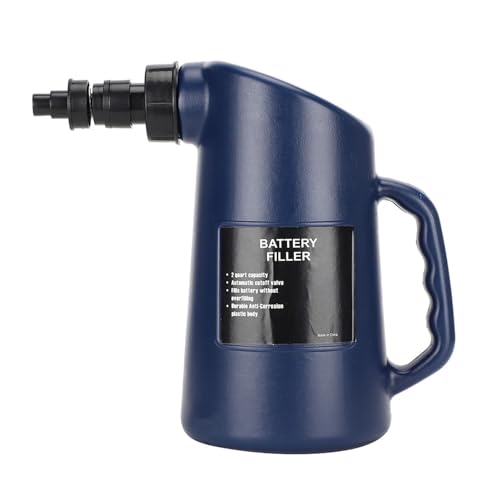
Phefop 2L Car Battery Filler, Batteries Drip Auto Shutoff Deep Cycle Battery Water Filling Bottle — the same auto-shutoff at a slightly lower price
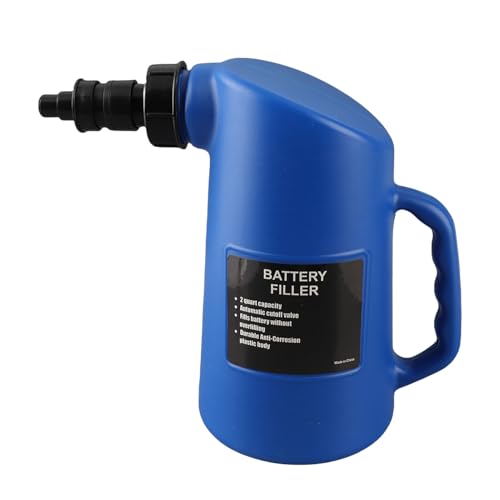
Functionally near-identical: 2L, auto shutoff at correct cell level, dual-action anti-drip nozzle, thickened PP/PE body. If you're buying one for a workshop shelf rather than a one-time job, the Phefop 2L Car Battery Filler, Batteries Drip Auto Shutoff Deep Cycle Battery Water Filling Bottle for Car Maintenance Equipment 2L Filler, Double Action Anti Water does the same job of keeping plates covered without flooding the cell. Check current listings and reviews yourself to see which of the two is stocked and priced better on the day.
FAQ
How often should I actually charge a battery I drive daily? If your commute includes 20+ minutes of steady driving and your alternator reads 13.5–14.5V, you likely don't need to. If you do mostly sub-10-minute trips, put it on a maintainer overnight once a month.
Can I leave a smart maintainer connected all winter? Yes — that's what the float stage is for. A charger that auto-stops or floats when full, like the ones with multi-stage MCU control listed above, is designed for exactly that. A dumb constant-output charger is not.
Is distilled water really necessary, or is tap water fine? Distilled only. Tap water carries minerals that plate onto the cells and accelerate self-discharge. It's a few dollars to do it right and a battery to do it wrong.
My battery reads 12.6V but the car still cranks slowly. What now? Voltage tells you state of charge, not health. A battery can read full and still fail under load. Check terminal tightness and cable condition first, then get a load test or conductance test — most auto parts stores do it free.
Related guides
- FAQ: Best car diagnostics, charging and accessories - OBD2 scanners, car battery jump starters, EV chargers and portable car battery chargers
- OBD2 Scanner Buying Guide: How to Pick the Right One
- About Our Best car diagnostics, charging and accessories - OBD2 scanners, car battery jump starters, EV chargers and portable car battery chargers Process
Key Takeaways
- Choosing the right car battery maintenance tips extend life means matching the key features to your specific needs and budget
- Read real customer reviews and check the return policy before you commit
- Compare value across models — the priciest option is not always the best fit