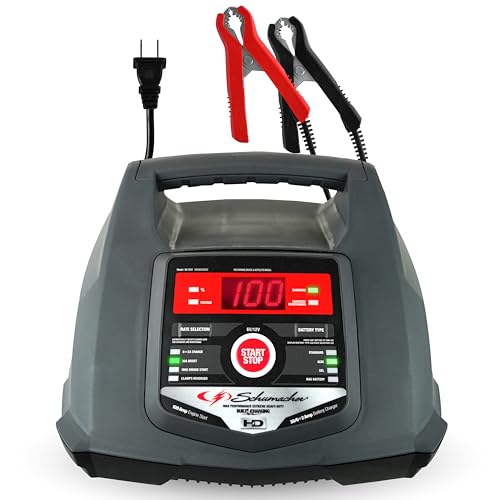
Quick answer: The Schumacher Electric 6A Car Battery Charger & Maintainer, 6V/12V – SC1281 is a $89.99 bench-style charger that bundles five jobs into one box — engine start, charge, maintain, test, and desulfate — for both 6V and 12V batteries. Its headline number is a 100-amp engine start, backed by a 12A–30A boost charge and a microprocessor-controlled 2A–6A charge for slower, safer top-ups. If you keep more than one vehicle and want a single unit that handles the whole battery lifecycle rather than a dedicated trickle charger, this is the size of tool you're looking at.
Specifications
| Spec | Schumacher SC1281 |
|---|---|
| Price | $89.99 |
| Brand | Schumacher Electric |
| Battery voltages | 6V and 12V (automatic voltage detection) |
| Engine start | 100 amps |
| Boost charge | 12A to 30A |
| Standard charge rate | 2A to 6A, microprocessor-controlled |
| Functions | 5-in-1: start, charge, maintain, test, restore |
| Maintenance mode | Smart trickle charge, automatically maintains voltage |
| Battery reconditioning | Advanced desulfation mode |
| Charging control | Multi-stage charging algorithms |
| Stated vehicle types | Cars, motorcycles, ATVs, trucks, SUVs, boats |
| Battery chemistries supported | Not stated |
| Display type | Not stated |
| Reverse hook-up protection | Not stated |
| Weight / dimensions | Not stated |
| Warranty | Not stated |
| In the box | SC1281 charger, user manual |
A note on that table: the blanks matter as much as the filled cells. Schumacher's product data for the SC1281 doesn't spell out AGM/gel/deep-cycle compatibility the way its sibling models do, and it doesn't state reverse hook-up protection either. That doesn't mean those things are absent — it means you should confirm them on the listing and in the manual rather than assuming.
Who the SC1281 is for
People with a fleet of small stuff. The 6V/12V automatic voltage detection is the quiet hero here. If you've got a car in the driveway, a motorcycle in the garage, an ATV, and maybe a boat battery on a shelf, you otherwise end up owning two chargers. Schumacher lists all of those vehicle types for this unit, and the 6V side covers older equipment and small powersport batteries that a 12V-only charger simply can't touch.
Finding the right schumacher sc1281 battery charger review comes down to matching the features to how you will actually use it.
People who want a jump without a jump pack. The 100-amp engine start means that when a battery is flat enough that a 6-amp charge would take all afternoon, you can put enough current into the system to crank the engine now. That's a different use case from a lithium jump starter — you're tethered to a wall outlet — but it never needs recharging itself and won't be dead when you reach for it in January.
People storing a vehicle. The smart trickle charge is designed to be left connected, maintaining voltage over time. Combined with desulfation mode, this is aimed squarely at the seasonal-vehicle problem: the bike that sits from October to April and comes back with a battery that won't hold a charge.
People who like knowing the answer before the repair. Battery testing is built in. That saves a trip to the parts store to find out whether you're replacing a battery or chasing an alternator.
Who should skip it
If you only ever maintain one 12V car battery, you're paying for capability you'll never use. The 6V circuitry, engine start, and boost charge are all dead weight in that scenario. A simpler maintainer costs less and does the one job.
If you need a fast shop charge. 12A–30A boost is respectable for a bench unit, but if you're recovering deeply dead batteries several times a week, or you want a 60-amp rapid charge, this isn't that class of machine.
If you specifically need lithium-ion support. The SC1281's stated feature set doesn't mention lithium chemistry. Assume it's not covered unless the listing says otherwise.
If portability is the actual requirement. This plugs into the wall. If your problem is "my battery dies in parking lots," a jump starter is the right tool, not this.
Honest trade-offs
The 5-in-1 framing is genuinely useful, but it also means every individual function is good rather than exceptional. The 100-amp start will crank most four- and six-cylinder engines but it's a fraction of what a wheeled starter delivers. The 2A–6A charge rate is gentle and battery-friendly, which is the right call for longevity, but it means a large, deeply discharged truck battery is an overnight job unless you use boost.
At $89.99 it sits above simpler maintainers and well below shop-grade equipment, and that's the honest positioning: it's the do-everything unit for a home garage, not a professional's primary charger.
The specs Schumacher doesn't publish for this model are the real caveat. Battery chemistry compatibility is the big one — if you're buying this for an AGM or deep-cycle marine battery, verify it explicitly rather than inferring it from the fact that it's a Schumacher.
What to check on the listing before you buy
Listings change more often than reviews get updated, so check these yourself:
- Current price. The $89.99 figure moves. Compare it against the sibling models below before committing — the gap between them is sometimes small enough to change the decision.
- Model number in the title. Schumacher's lineup is dense with near-identical part numbers (SC1280, SC1281, SC1361, SC1363). Confirm the listing you're on actually says SC1281 and not a variant, and check which voltages that specific variant supports.
- Warranty terms. Not stated in the product data. Look for the coverage period and whether registration is required.
- Battery chemistry compatibility. If you're charging AGM, gel, or deep-cycle, confirm on the listing page and in the downloadable manual.
- Owner reviews and Q&A. Go read them yourself — the Q&A section in particular is usually where people ask exactly the compatibility question you're wondering about.
Alternatives worth a look
Schumacher Electric Car Battery Charger 12V/6V - Trickle Charger, Maintainer for Automobile & Marine Batteries (AGM/Gel/Deep Cycle) - SC1280 — consider instead if…
…you want explicit AGM, gel, and deep-cycle support and a digital display. The Schumacher Electric Car Battery Charger 12V/6V - Trickle Charger, Maintainer for Automobile & Marine Batteries (AGM/Gel/Deep Cycle) - SC1280 is $64.99 and its stated features cover 6V/12V standard, AGM, gel, and deep-cycle batteries — chemistry coverage the SC1281's data doesn't spell out. It delivers 15A rapid charging, has a built-in display showing voltage and percent charge, and includes reverse hook-up protection. No engine start, though.
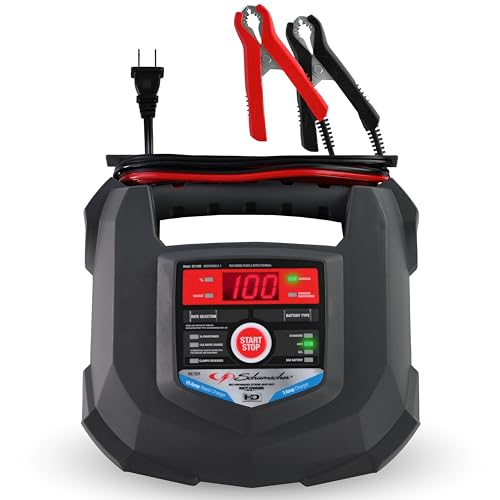
Schumacher Electric 6A Car Battery Charger & Maintainer, 12V – SC1361 — consider instead if…
…you never touch 6V batteries. The Schumacher Electric 6A Car Battery Charger & Maintainer, 12V – SC1361 is $80.48 and is a 3-in-1: starts, charges, maintains. You get a 50-amp engine start and 10-amp boost, plus explicit reverse hook-up protection that stops the unit operating if clamps are backwards. Less capable, but simpler and 12V-only.
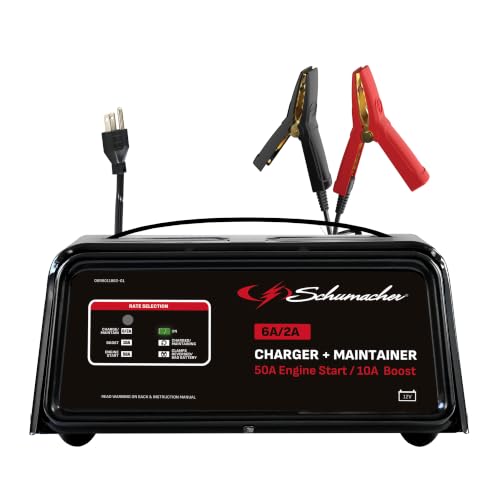
Schumacher Electric 8A Car Battery Charger & Maintainer, 6V/12V – SC1363 — consider instead if…
…you want 6V/12V coverage and desulfation but don't need engine start. At $65.99, the Schumacher Electric 8A Car Battery Charger & Maintainer, 6V/12V – SC1363 actually charges at a higher 8A rate on 12V (down to 2A), does 2A on 6V, works with standard and AGM types on gas and diesel vehicles, and includes reconditioning via desulfation mode. Cheapest route to the maintain-and-recondition core.
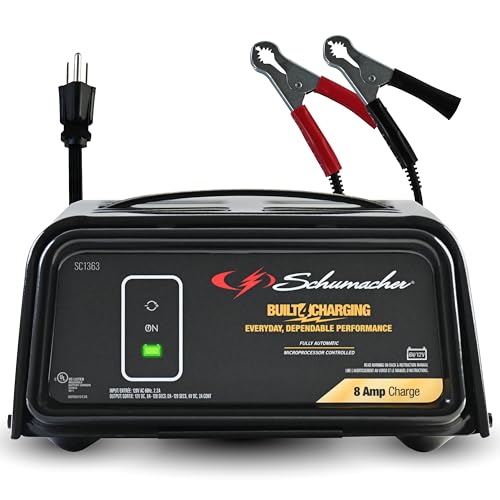
Schumacher Electric Wheeled 10A Car Battery Charger & Maintainer – SC1445 — consider instead if…
…the SC1281's 100-amp start isn't enough. The Schumacher Electric Wheeled 10A Car Battery Charger & Maintainer – SC1445 is $189.99 and delivers a 250-amp engine start with 25A and 50A boost charges, a 135-minute manual timer, and support for 6V/12V standard, AGM, gel, and deep-cycle across automotive, marine, and powersport.
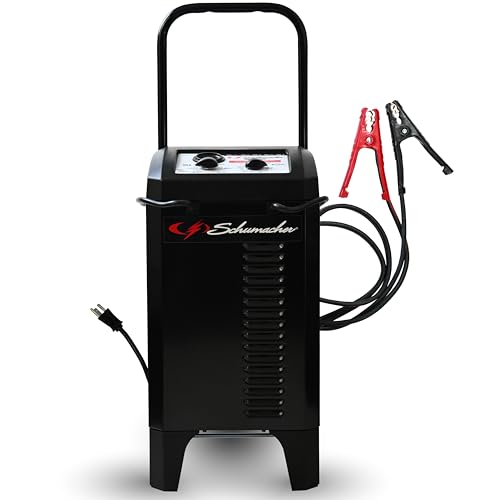
Schumacher Electric 60A Car Battery Charger and Maintainer, Manual and Automatic Operation, Battery Tester, DSR Professional Grade, for 6V/12V Automotive and Marine Batteries, DSR134 — consider instead if…
…this is a shop, not a garage. The Schumacher Electric 60A Car Battery Charger and Maintainer, Manual and Automatic Operation, Battery Tester, DSR Professional Grade, for 6V/12V Automotive and Marine Batteries, DSR134 runs $599.99 for 60-amp rapid charging, lithium-ion support alongside standard/AGM/gel/deep-cycle, four charging modes, bad battery detection, and recovery mode.
FAQ
What's the difference between the SC1281 and the SC1308? The SC1308 isn't covered in the data here, so we won't guess at its specs. What we can say concretely about the SC1281: 100-amp engine start, 12A–30A boost, 2A–6A microprocessor-controlled charge, 6V/12V auto-detection, and five functions including testing and desulfation. Compare those specific numbers against whatever the SC1308 listing states.
Can I leave the SC1281 connected all winter? That's what the smart trickle charge is designed for — Schumacher states it automatically maintains voltage over time so you can leave the charger connected without worry. Multi-stage charging algorithms handle the transitions.
Does the SC1281 replace a jump starter? Not really. It has a 100-amp engine start, but it's mains-powered, so it only helps where there's an outlet. For roadside failures you still want a portable pack.
What does desulfation mode actually do? It's listed as a battery restoration function aimed at extending battery life and performance. It targets sulfate buildup on the plates of a battery that's been sitting discharged. It's a recovery attempt, not a guarantee — a genuinely dead cell stays dead.
Related guides
- Best car diagnostics, charging and accessories - OBD2 scanners, car battery jump starters, EV chargers and portable car battery chargers for Small Business Owners
- Alternative Options for Best car diagnostics, charging and accessories - OBD2 scanners, car battery jump starters, EV chargers and portable car battery chargers
- ChargePoint Home Flex Review: Is It Worth $494?
Key Takeaways
- Choosing the right schumacher sc1281 battery charger review means matching the key features to your specific needs and budget
- Read real customer reviews and check the return policy before you commit
- Compare value across models — the priciest option is not always the best fit